July 28th, 2008

Larry Polansky is a composer, performer, theorist and professor who has been working since the ’70s at places like Mills College and Dartmouth. He’s also a founder of Frog Peak Music (A Composer’s Collective). The Theory of Impossible Melody is a 1989 collection of computer music pieces composed from 1975 to 1989. Highlights include “B’rey’sheet” (1985)—an amazing piece for nice female vocals and interactive computer. Sonic mayhem ensues as the computer-guided synth sounds and human vocals—initially out of whack with each other—both share the same melody by the time all is said and done. Some nice held synth notes will also trance you out along the way. “The soloist sings the melody unaltered. The computer reacts to the voice harmonically, rhythmically, melodically and timbrally, gradually constraining its variations until the voice and computer are in unison.”
Read the rest of this entry »
No Comments » |
Larry Polansky |
Permalink
Posted by Arcane Candy
July 28th, 2008

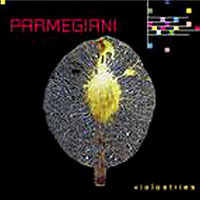
Along with the François Bayle and Ivo Malec 2-CD sets, The Violostries… 2-CD is one of the major continents on the INA-GRM planet and is a required layover for any wayward electro-acoustic music fan. These two discs divide his career into two eras: tape splicing and mouse clicking. “Violostries” (1963) is comprised of a sustained, ominous atmosphere punctuated with violent electro bursts and spooky, tweedling violin. “Pour en Finir Avec le Pouvoir d’Orphée” (1971) is a very mesmerizing pleasure fun center full of glimmering electronics building in intensity—only to give way to downwardly circling whip-cuts, metallic crashes and echoes of the deepest kind. A very empty area of low pulsations with high-pitched tinklings again amplifies and builds in intensity—eventually turning into a swirling mass of rare beauty that abruptly comes to a sudden, beeping stop. Following that is a rather “happy” section of boinging electronic “springs” and whistles that slowly coalesce with a low-pitched drone into a hectic area of stuttered percussive sounds.
Read the rest of this entry »
No Comments » |
Bernard Parmegiani |
Permalink
Posted by Arcane Candy
July 28th, 2008

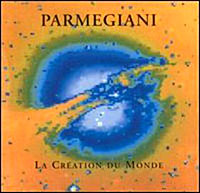
Bernard Parmegiani has been making stunning electro-acoustic music since 1959. Have you? La Création du Monde (1982-84) is basically the big bang theory of universal origin rendered in sound, divided into three sections. “Black Light” is an atonal, white-noise journey—pre-explosion—as “the dreamer of the world plunges down unendingly into his own depths as he strives toward the point from which he originates. Black light…a fermentation of latent, incommensurable energies with no conscious strategy. The echo within the echo increases space exponentially. Everything is set to begin.”
Read the rest of this entry »
No Comments » |
Bernard Parmegiani |
Permalink
Posted by Arcane Candy
July 28th, 2008

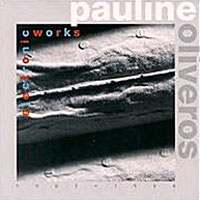
The Electronic Works CD contains three more pieces from the same time period as Alien Bog / Beautiful Soop, the 1960s. “I of IV” (1966) was originally released on the New Sounds In Electronic Music LP, which also featured Richard Maxfield’s “Night Music” and Steve Reich’s infamous “Come Out.” It’s a heavy 25-minute dreamville of electric nightmare bleeps, buzzes and pulsations made at the University of Toronto Electronic Music Studio. “It’s a real-time studio performance composition with no editing or tape-splicing, utilizing the techniques of amplifying combination tones and tape repetition. The combination tone technique was one that I developed at the San Francisco Tape Music Center. The equipment consisted of 12 sine tone square wave generators connected to an organ keyboard, two line amplifiers, mixer, Hammond spring-type reverb and two stereo tape recorders.”
Read the rest of this entry »
No Comments » |
Pauline Oliveros |
Permalink
Posted by Arcane Candy
July 28th, 2008

This is one of two companion CD reissues of Pauline Oliveros’ electronic works of the 1960s, made when she was the first director of The Tape Music Center at Mills College. “Alien Bog” (1967) was previously excerpted on the old Music From Mills 3-LP and is presented here for the first time in its entire length of 33 minutes. It provides an appropriate soundtrack for 3:00 a.m. refrigerator visits with video game-like bleeps and bloops over a frayed, dark landscape of buzzing and echoing electronics. “Beautiful Soop” (1966, debuting here) is similar, but with some distinguished British voices that are echoed and delayed from speaker-to-speaker reciting absurd surrealist poetry: “He thought he saw a buffalo up on the chimney piece. He looked again and found that it was his sister’s husband’s niece.” Both tracks were produced using the original Buchla Box 100 series created for The Tape Music Center by Don Buchla, along with Pauline’s tape delay system, which consisted of running the tape from one machine to another. “I was deeply impressed by the sounds from the frog pond outside the studio window at Mills. I loved the accompaniment as I worked on my pieces. Though I never recorded the frogs, I was, of course, influenced by their music.”
Label: Pogus Productions Catalog Number: P 21012-2 Format: CD Packaging: Jewel case Tracks: 2 Total Time: 61:04 Country: United States Released: 1997 Related Artists: Stuart Dempster, Morton Subotnick More Discogs, MySpace, Official, Wikipedia
No Comments » |
Pauline Oliveros |
Permalink
Posted by Arcane Candy
July 24th, 2008

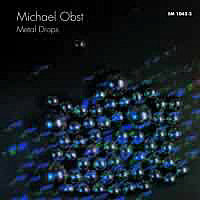
Michael Obst (1955) is a young German composer and successful concert pianist “specializing in contemporary music” who has also been working in the electronic realm since 1979. This 1992 CD is a reissue of an LP from the early ’80s. The 25-minute “Inside (Infinite Chambers)” lives up to it’s beautiful title by successfully hovering a very spare and austere sound-realm into your view, only to occasionally bust out with large heating duct or jet engine-like bursts. The sound sources—violin, violoncello, piano—are electronically altered, mostly beyond recognition. “The manipulation of the single sounds in the motif groups at the beginning of the work leads in the course of the piece—and especially toward the end—to sound surfaces and ‘walls’ and thus to the development of a special feeling of space and time.”
While the overall feel of “Metal Drop Music” is similar to “Inside,” the piece is less of an epic (at only one third the length) and is more outright outbursting. Also, unlike the former—which uses concrète sounds as the source—the latter is composed entirely of sine tones produced by the ARP synthesizer. “The point of departure for this piece was the attempt to produce very rapid complex sound groups which consist of pointedly articulated single sounds. The desired sound-occurences were intended to have a random quality comparable to the acoustical result of glass beads striking a flat surface.” Produced on a EMS Synthi 100, “‘Ya-Na-Je’ uses three distinct musical materials: motif groups, surfaces and apparently endless streams of sounds. These ‘themes’ are varied so that the initial assertion of their characteristics dissolves, giving way to a more meditative quality. In this way, the piece gradually achieves more space and depth.”—Michael Obst
Label: Wergo Catalog Number: SM 1043-2 Format: CD Packaging: Jewel case Tracks: 3 Total Time: 48:55 Country: Germany Released: 1992 Related Artists: Karlheinz Stockhausen More Discogs
No Comments » |
Michael Obst |
Permalink
Posted by Arcane Candy
July 23rd, 2008

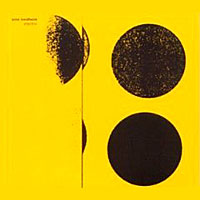
A really beautiful and austere double-foldout digi-pak–emblazoned with large, crudely xeroxed dots on an orange background with tastefully small typesetting–contains some of the best electro-acoustic works from the late ’60s and early ’70s, originally released on vinyl in 1974. Physically and sonically, this almost seems like a companion volume to the Edgardo Canton and Vittorio Gelmetti CDs on Nepless. Collect all three!
“‘Solitaire’ (1968) is the name of the most austere diamond setting in which all of the stone’s sides are open and refract light. However, ‘Solitaire’ may also be transcribed as ‘alone,’ and this beautiful and glittering timbre landscape may also stir feelings of something both alien and alienated. A ‘virtual’ space in which we experience the human voice as it pierces this rushing soundscape, with the effect being one of nakedness and loneliness in an all-encompassing whole. The piece’s shimmering and crystalline sound is largely developed from recordings of poetry readings.” A solemn drone with icy reverberations fades in quietly—gradually amplifying to a loud climax—then floats back out slowly to way deep space-pulses. Cash register-like crashing glass, mangled tape-cuts and twittering ice splices thunder into view, very much like a sped-up “Concret P-H.” The piece continues with heavy thunder, ambient tones, reverbed voices, machine gun echoes and shrill, bell-like sounds. A period of silence follows, then comes a reprise of the original opening gush, along with some sparse tinks, echo-spliced ice and an “organ” fade out.
Read the rest of this entry »
No Comments » |
Arne Nordheim |
Permalink
Posted by Arcane Candy
July 23rd, 2008

This is a reissue of an old LP originally released at the 1962 Seattle State World’s Fair. The music for Man In Space With Sounds was composed in 1951, recorded in 1959 and finally, in 1962, piped into a ride at the Fair called The Bubbleator: a 150-capacity, clear, plastic sphere that ushered visitors through The World of Tomorrow exhibit—“a maze of cubes containing pictures of the hope and havoc of space and the atom.” Two versions of the album existed–both of which are included here–one with just music and the other with classic, corny spoken introductions to each track: “Stand by for surprises! Here in the Science Pavillion are dazzling demonstrations of what tomorrow’s science holds in store—the dramatic facts about coming breakthroughs in space exploration, custom-made weather and man’s triumph over disease!”
All of this is from back in the innocent days of long ago when official forecasters, futurists and Disney alike promised that we’d soon be dwelling in glistening white utopias with hovercrafts and monorails flying around–not to mention vacations on the moon. On the album, all kinds of beeping, whistling, crashing and echoing electronics are scattered perfectly over really syrupy, Disney movie-like instrumental music. Excellent. This CD reissue was sorely needed, comes highly recommended and is really super fun to listen to. It was also briefly available as an LP reissue in a limited-edition of 500 copies from the Spanish label Wah-Wah Records.
Label: Subliminal Sounds Catalog Number: SUBCD 4 Format: CD Packaging: Jewel case Tracks: 24 Total Time: 61:00 Country: Sweden Released: 1998 Related Artists: Louis and Bebe Barron, Raymond Scott More Last.FM, Space Age Pop
No Comments » |
Attilio Mineo |
Permalink
Posted by Arcane Candy
July 23rd, 2008

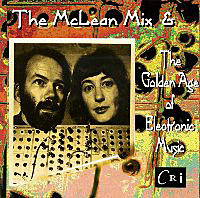
Husband and wife duo Barton and Priscilla McLean have been at it since the early ’70s, and this CD reissues a couple of old Folkways and CRI LPs from that decade. “A central focus of their often abstract electro-acoustic music has been sounds and images of nature and primal forces of creation. The Golden Age of Electronic Music refers to the period of the ’70s when analog synthesizers were at their most powerful and many fascinating works were being created using these with multi-track reel-to-reel tape recorders, noise-reducing equipment, analog processors and large mixers. The equipment, large and cumbersome, spanned the four walls of the studio and the composers would often run back and forth between stations, spending as many as 22 hours at a time to develop one complex sound.”
Read the rest of this entry »
No Comments » |
The McLean Mix |
Permalink
Posted by Arcane Candy
July 21st, 2008

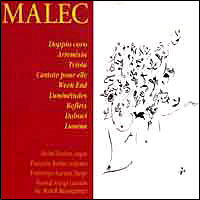
A member of the GRM since 1960, Ivo Malec was professor of composition at The Paris Conservatoire from 1972-1990. Over the years, he has composed orchestral, instrumental, vocal, stage and electro-acoustic works, plus mixed-media efforts combining instrumental and electro-acoustic music. This 2-CD set—spanning from 1961 to 1993—is a big and impressive overview of his career. “Doppio Coro” (1993) was originally intended for organ and magnetic tape, but turned into an 18-minute solo organ affair after the tape was misplaced. It was a redeemable loss, however, as these monolithic slabs of stark, scary and dramatic organ work prove. The title “Artemisia” (1991) is “an affectionate reference to that secret, exemplary woman, Artemisia Gentileschi,” a 15th century painter and “one of the first women to have supported, through her words and her works, the recognition of an intellectual equality of the sexes.” It’s filled with bouncing concrète notes, various shimmering and spiraling electronics, abrupt echoing sounds, totally hectic chirp collages and quietly percolating electronics with occasional explosions.
Read the rest of this entry »
No Comments » |
Ivo Malec |
Permalink
Posted by Arcane Candy