I Wayan Lotring
The following text originally appeared as liner notes for Le Gamelan Balinais de Lotring 2-LP (Ocora).
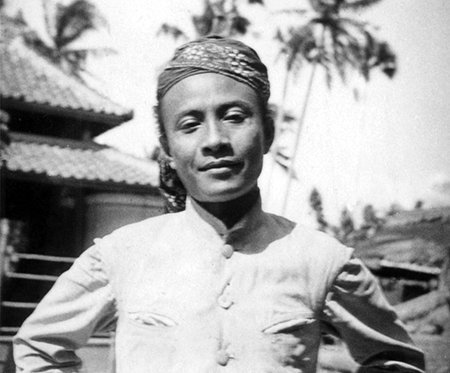
I Wayan Lotring stands in front of the balé banjar of Banjar Tegal in Kuta, Bali, circa 1931-’38. Photo by Colin McPhee.
Lotring? You pout, because you don’t recognize the name Lotring. Among music lovers and musicians in the West, it hardly provokes any response. And yet on the other side of the world—in Bali—pronounce the name Lotring in front of a city dweller, a peasant or a teenager and you’ll see before you a face that lights up and who, seeming to dream of the stars, says, “He was a great musician” as the memory of the most brilliant gamelan music immediately buzzes in his ears.
Lotring is an almost magical name in Bali. Every musician (but isn’t everyone a musician in Bali?) has played a composition by Lotring during long evenings of rehearsals, or during a temple festival. Likewise, a graceful dancer whose performance you may have just admired was once his student. Even though you may not be aware of Lotring, it’s safe to say Balinese music is him! Lotring is quite a legend. In Bali, many people (other than those in his village) believe he is dead. Some say he’s been gone for four or five years, while others insist it’s been at least 10 years. Lotring is already part of the musical mythology in a country where an artist’s soul is the most envied and sacred gift of nature that the gods can grant.
According to the Balinese, Lotring is at the origin of everything: the music of Legong Kraton (which is true); many compositions of the gong kebyar (which is false, because he admitted to me recently that he remained indifferent to the increasingly rapid rhythms and tempi of this music in full development); the gambangan, a brilliant creation of a rhythm based on the model of an ancient sacred music (which is what made him famous); and the main compositions of the gender wayang (the first instrument he ever played) for shadow theater.
But who is Lotring? He was born in 1897 in Kuta, a small fishing village in the South of Bali, which has now become a seaside resort. His father, I Rapih, a fisherman by trade, was part of a music and dance club at Bandiar Tegal, of which Lotring is still one of the pillars today. His mother Nji Gulbig, a good woman, took little interest in music and dance. His parents gave him the first name Wayan, as always with the first child of the family. Lotring’s youth was spent in an extraordinary musical atmosphere. As soon as he was old enough to talk and walk, his grandfather and father, struck by the child’s precocious dispositions, put him on the keyboard of the gender and a small bench was specially made for him so that he could reach the height of the keys.
At the age of six, he played every evening with the members of his family and already accompanied the shadow theater sessions. He was then called to the court of the Prince of Blahbatuh and became a Nandir dancer, a court dance performed by little boys dressed in white, which has now disappeared. From there was born the magic of the Legong Kraton, an admirable dance of purity. So, Wayan Lotring danced while learning the art of the court gamelan, the gong sema pegulingan, which he could no longer do without. During the day, he went fishing with his father, and never went to school. He was basically illiterate until his forties.
1906 saw the arrival of the Dutch and the end of feudalism. Lotring was nine years old and already had mastered his art. No more dancing at the princes’ houses, no more evenings in palaces lit by torches. Lotring has had time to learn. The art of shadow theatre no longer held any secrets for him, and a few months later, he became one of the greatest dancers in Bali and his fame quickly grew beyond his province.
The music of the gender wayang is all Lotring. He composed for that instrument first, which quickly became his favorite. He created melodies that in a few months everyone would play. He practiced almost every night and was already considered a great musician. At that time, Lotring had a semar pegulingan made from a very old village gamelan. He ordered the metal from Semarang, Java, which controlled the quality of the metal. He studied the alloys and entrusted the manufacture of the orchestra to the blacksmiths of Klungkung. It was the most beautiful gamelan in Bali!
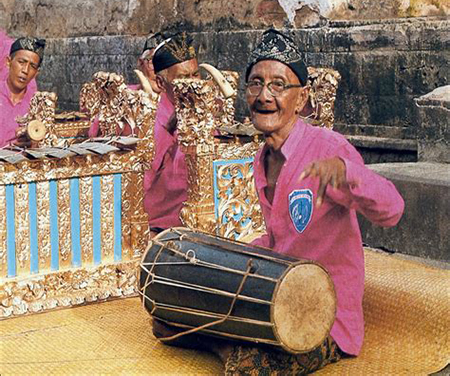 I Wayan Lotring plays with his group in Kuta, Bali, October 1972. Photo by Jacques Brunet.
The semar pegulingan is the real crystal, the water that flows from the still pure source. It is the voice of the gods. As the gamelan formerly reserved for princes, it was made with infinite care. And never in Bali will we have heard more beautiful, more perfect music than this. And Lotring’s gamelan became the most beautiful. What metal! The great suspended gong is a splendor. All by itself, it is music, and Lotring is the master of the orchestra. It is a masterpiece born at the same time from fire, from the magic formulas of the blacksmith and from the selected metal.
It is true that in Semarang they had melted down an old gamelan from the court of a Javanese sultan. Perhaps a gamelan from Modjapahit, a great Hindu empire of the 15th century. So, with such a tool, Lotring composed melodies and created the Legong Kraton, a dance for three little girls in a style inspired by the outdated nandir. Tjondong, Pelayon, Kuntil, Sekar Elet, Djobog, Tjandra Kanta, Lasem, Kapi Radja, Solo, Guak Natjok and 30 other compositions that were all included in the Legong repertoire.
At the same time, Lotring continued to compose for the wayang genre masterpieces of grace and musicality: Merak Ngélo, Pemungkah, Angkat-Angkatan, and especially Sekar Ginotan. Then everyone wanted to learn his music. He went around of the island with his musicians and his dancers of Kuta and gave lessons with the two other great artists of Legong, the late Njoman Kaler and Putuh Gerija. Lotring created Legong groups wherever he was asked, like Peliatan, where he taught and then played with one of his most gifted students, Prince Anak Agung Gedé Mandera, who still leads his prestigious orchestra today, Perean, Bedulu, Gianjar and dozens of others. He also composed a new repertoire for the Barong ritual that he found too poor, including Sisyan, a small masterpiece of rhythms.
Then around 1920, a musical storm passed over Bali that would mark Balinese artistic life for several decades. From the North, a new style was born, the kebyar, which all of the villages would fall in love with. The gamelan-gong kebyar became an orchestra with powerful sounds to which new, larger keyboard instruments were added, and the virtuosity required exceeded anything that had been imagined until then. The semar pegulingan seemed like a small chamber orchestra in comparison. The kebyar swept everything away all the more since at the same time began the career of a very great dancer, Mario, who created choreographies in the style of the kebyar and whose fame traveled around the world. Lotring did not attach himself to this modern style. He remained faithful to his semar pegulingan and its sounds coming from paradise.
To launch Mario as a dancer, Lotring composed for him a melody on which Mario created one of his first dances. Wanting to learn everything about Balinese music, Lotring traveled around the island, working with the great musician of the north, Gedé Manik, the one who created the kebyar. He also met the musicians of Karangasem in the East of the island, Diembrana in the West, Bangli, Klungkung, and even the neighboring island of Lombok. Lotring tried to combine in his new compositions the old and the new style. Thus he composed Salendro, Ganduh, Djajaraga, etc.
As sensitive as ever, Lotring found his inspiration in nature, the water of a flowing torrent, a singing bird. Some of these compositions show a great deal of humor. Such as this story that Lotring told me one day: he had just given a party at the home of a prince from the area who gave him 2.50 rupees as his salary. Back home, Lotring wanted to use this money to buy something but lost it. He began to search on the floor, under his chair, and turned around the table several times. Annoyed yet simultaneously amused by this game, he thought up the idea of a new melody whose rhythm was based on the movement he had just made with the furniture. Thus was born Liar Samas, composed in praise of lost pennies.
A century earlier, Beethoven, who had found himself in the same situation, wrote a little rondo in G major. But Liar Samas was for Lotring one of the most original compositions of its time, and one that he always kept in his repertoire. The American musicologist Colin McPhee, who knew Lotring well in the 1930s, made a striking portrait of him: “Lotring seemed to me to be the spirit of all that was life and creation. He was warm and kind, simple-minded, even illiterate, with a smile that went to the heart. Although, when I knew him better, I found him vague and inconsistent in musical theory, he was, when he came to play, a clear-headed critic and a superb artist, and the music I learned from him was the most beautiful of all that I heard on the island.
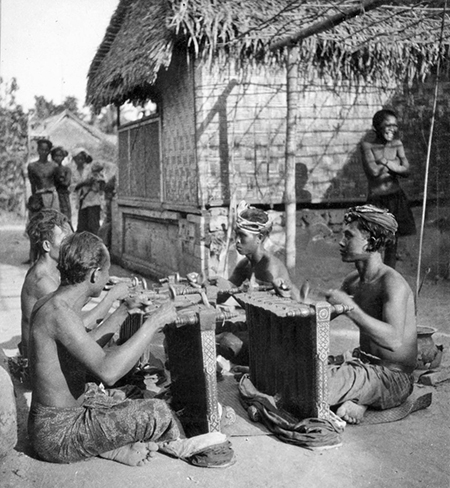 Gendér Wayang of Banjar Tegal in Kuta, Bali, circa 1931-’38. I Wayan Lotring on the left. Photo by Colin McPhee.
“He spoke of himself in the romantic terms of real composers, and had it not been for the modest and rather tormented tone of his voice, I should not have believed him. How did you begin a new composition, Lotring? ‘Who can say? Sometimes a melody comes by itself, sometimes from something I have heard. For example (he laughs), I got the idea for a play from hearing a clock. So what? A Chinese man here in Kuta had a little clock that played a tune every hour. It was really nice! I listened to it often. I could not forget this tune. One day, I used it in a piece for the gamelan of Kuta. And soon everyone around Denpasar wanted to learn it.’”
In fact, nothing in Lotring’s compositions recalls the melody of a clock but he used the sounds of the outside more as a means of departure than as a melodic or rhythmic support. “It’s hard to compose. Sometimes when I’m thinking of a new composition, I can’t sleep for nights. I lost my hair from thinking about music.” In the 1920s, his fame crossed borders. He was invited several times to Java and played for the Sultan Paku Buwono of Surakarta (in 1922) with the dancer Ida Bagus Boda.
After seeing the Javanese dances that the sultan showed him, Lotring gave the name Lègong Kraton to the dances he had created a few years earlier. Lotring once told me about his stay with Buwono, which left an unforgettable memory: “The Javanese king had a dazzling court in his immense kraton (palace), even more beautiful than those of our ancient kings. He was kind, passionate about art, and especially curious about music and dance. He received me like a prince because I was an artist!
“He organized several musical evenings for me and my group. I conducted my gamelan, and then the musicians from his palace performed melodies that I found very slow. I told him that in my opinion there were no nerves, at least according to the Balinese perspective, in this music, but that his dances were very beautiful. He laughed and said my dances were very beautiful, too. I then told him that the beauty of the Legong recalled that of Javanese dances and that they were also like the Legong Kraton dances that deserved to be performed in the royal palaces! Since then, the name has stuck and the Legong Kraton became the most famous dance of Bali.”
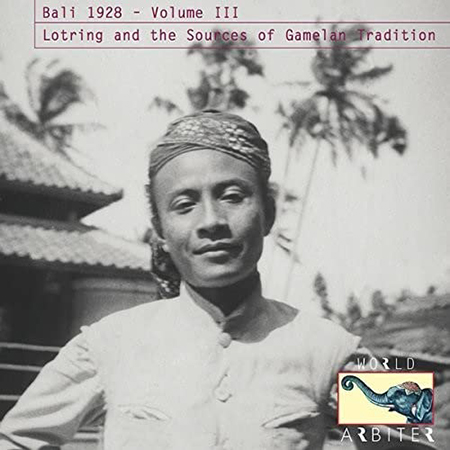
In 1936, Lotring toured Ceylon for a few weeks with his entire orchestra and his dancers. Around this time, people across Asia started hearing about him. The greatest dancers of India insisted on making the trip to Bali to visit him. Artists from Siam and even Japan met him, thus establishing his reputation as being the greatest musician of the far east. As for the west, Lotring’s name had touched a few initiates. At the dawn of electrical recording in 1928, German technicians from the labels Odeon and Beka came to record (with all the material difficulties that this represented at the time) the great musicians in Bali. They then published a dozen of Lotring’s compositions on 78 rpm records [which are now available on CD from World Arbiter].
Then came the war and the invasion of the Japanese. Lotring stopped composing and only played in his club. By then, kebyar had become the most popular musical style on Bali. Each village had its kebyar gong and many dances had emerged in this new style. Something had changed in Balinese art. 1946 saw the arrival of another calamity, which has continued to this day: tourism., Eager for exoticism, colorful dances and spectacular music, tourists would unconsciously consider the kebyar the most representative genre of what they came looking for.
It is true that the semar pegulingan, with its subtle sounds and impalpable nuances, was not made to satisfy the insatiable hunger of ignorant Westerners. Lotring had his day. He was from the pure Bali before tourism, where the song of a clock was enough to create a world. Lotring continued for some time to play here and there. In the meantime, several quarrels between the musicians of his club had broken the momentum of their collaboration. For years, Lotring remained without musicians and therefore without a gamelan. He was getting old and so were his musicians. The cold and almost boring but spectacular perfection of Peliatan’s gamelan, and the new dances in which the pure art of Balinese movement was gradually replaced by a realistic and whiny choreography (but more comprehensible for the foreign visitor) were favored by the new public.
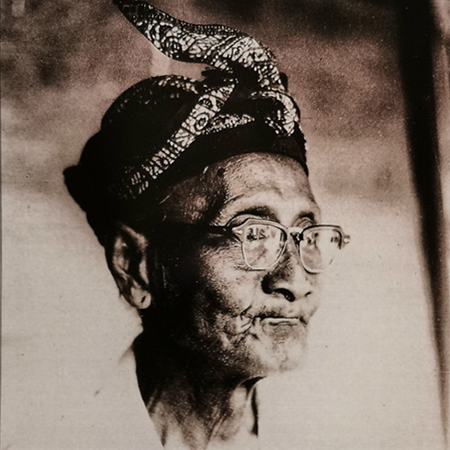 I Wayan Lotring circa early-1970s. Photo by unknown.
It was almost over for the art that Lotring had brought to its highest perfection. So, Lotring set himself the task of teaching. Some remote villages wanted to have a Legong, so Lotring went to these villages to teach. Always tireless, he still taught after 1950 to young children, some of whom later became admirable artists themselves. In the 1960s, Lotring fell ill and soon in Bali he was considered dead. In fact, having become very weak, he had stopped playing and the musicians of his club, also elderly, left their instruments to the younger musicians from the village. Of course, Lotring was still alive, but he had finished musically existing.
I met Lotring for the first time in 1970. I saw a small, sick and frail man who held out a trembling hand to me. Deaf, weakened by years of illness, he could not hold a conversation—longing above all, it seemed, to return to his room to lie down. But this brief appearance of the musician left me with the desire to see him again. His entourage had later shown me his gamelan, carefully preserved as a relic in the balé banjar, the club’s shelter; I was surrounded by some old men, who with the help of a few beers, spoke to me about Lotring, whose absence they felt with such sadness.
“A gamelan is not made to remain silent. It’s sad that Lotring is no longer able to lead us!” Then came many reminiscences: the gamelan competitions that they won every time when Lotring was there, those crazy nights of dancing where, tirelessly, the team of his musicians got drunk on sounds and rhythms, those eternal repetitions where the same melodic phrase was repeated a hundred times until the master seemed satisfied. And then a smile of pride: “There was a piece in our repertoire that was so difficult to play, only Lotring and our group were able to play it properly. When Lotring plays, he is inhabited by the gods, that’s for sure!”
Each year, I returned several times to Lotring’s house but the news about his health was hardly reassuring. Each time, we spent an evening with the old musicians of Kuta—his musicians—and we got on well. The legend of Lotring took on a new face each time through the evocations of the past through the smoke of cigarettes and between a few sips of rice alcohol. Lotring’s gestures and triumphs materialized from suddenly awakened memories emerging from the weathered faces of his friends.
These old people around me were probably the same age as him and it was a whole musical era of Bali that came back to life in the evening around the oil lamp, where Lotring stood out in filigree. He was sometimes the uncompromising man during rehearsals, his legendary energy in conducting his orchestra, his unquenchable passion for music, his taste for perfection, his pride in obtaining from his instrument what other musicians could not, his extreme modesty and his carefree attitude towards success, his love of nature (an inexhaustible source of his inspiration), his legendary humor, his joy of life and his taste for celebration—all of this was relived during many evenings.
One evening, Lotring felt better. “Lotring, you are 75 this year. Why not conduct your gamelan again and make a series of recordings? It would be a wonderful celebration!” “I already recorded in 1928, and I am too old,” he replied with a smile. He stayed with me a few moments and then went to bed. Three days later, his son-in-law came to see me. “Come this evening with your equipment! For two days he has taken his musicians in hand and they are rehearsing. It is wonderful. He would like to know the compositions that you would like to record.”
I arrived in the evening at the appointed time to the balé banjar. The orchestra was there in full rehearsal under the firm hand of the old musician. As soon as Lotring saw me, he came toward me. “I am very old,” he told me, “and we have been rehearsing all afternoon. These musicians are very old too and are no longer good for much, but we are doing what we can!” He told me to wait a little longer because he wanted to rehearse a piece that he was not satisfied with.
 I Wayan Lotring circa early-1970s. Artwork by @kuta_kumara.agung.
Lotring was transformed. He was no longer the old man I had met sometimes: his eyes were shining and his hands displayed on his drum an unsuspected strength for a man of his age, still ill. You should have seen Lotring with his hands in the air, uttering a grunt of discontent, exciting his musicians with a sign, stopping them to make them repeat a passage. His nervous hands seemed to want to draw the melody in the air. To better show what he wanted to achieve, he began to dance and his arms twirled around his drum. The musicians, imperturbable, watched him attentively; they knew the importance of this evening and for nothing in the world would they have given up their place.
Lotring stopped, signaling to me that we could start recording. “We are very old!” he repeated to me with a weak smile, and we began to record. After each recording, Lotring came to listen with headphones and it was astonishing to see this practically deaf man hear the slightest pianissimi. Very demanding, we had to start over five times on “Liar Samas” and three times on “Gambangan” before he gave me his agreement.
After three hours, he signaled to me that it was enough and that he was very tired. I had to accompany him home, supporting him by the arms. He laughed. “I am tired but happy!” he said to me. “But look at these musicians: They are younger than me but they have even more trouble keeping up with me!” And then abruptly: “We’ll continue tomorrow, won’t we?” He left me without looking back.
So, from October 2 to 11, Lotring spent some time by himself. Each day brought him new strength, and the music seemed to give him new vigor. Some pieces were rehearsed eleven times before being recorded. “He is inspired by the gods” an exhausted musician told me one evening, “Have you noticed the nuances he gives to his drum? At his age, it is still unique in Bali!” It is true that I had never heard a kendang held in this way. I had often been struck by the hallucinatory virtuosity of a Gedé Manik, this other musician from the North of the island, and many gamelan-gong leaders had fascinated me with the quality of their playing. But I had never heard so much subtlety in the striking of a drum, going from the caress of the hand or the fingertips to the shock of the entire palm engaged on the membrane, giving the impression that the drum went from confidence to the rumble of thunder.
“In my time, all music was only nuances,” Lotring once told me, “Today, only speed counts. But then if you play too fast, how can you make a gamelan sing? How can you make the voice of the gods heard between two gong strokes if the musicians always play louder and faster and faster? We play without a soul now! Listen, I sometimes even have to hold my old musicians back.” But why, Lotring? “The tourists, it’s because of them. They like what shines, what goes fast, and the Balinese make money that way. But I can only play for myself, to make myself happy.”
And then I can hear the gong (he turned to the large gong suspended from his gamelan). “Listen to how good it sounds! It is the opposite of me: the older it gets, the more beautiful and deep the sound it gives off! While I don’t become good for nothing [sad laughter], now my life is simple: every day I eat, I walk, I sleep, I eat, I walk, I sleep.” (Lotring daydreamed for a moment, then stroked the edge of the gong.) But he still sings. Listen to how he breathes! (He hit the gong with his fist, causing a series of sound waves to roll between the walls of the music club.) “There is nothing more beautiful! It’s the voice of the spirits, but it is also the heart of my gamelan, and that is the blood of music! Each instrument feels it, reacts to its call. Balinese music is beautiful!”
Another day I challenged Lotring on his way of composing. He burst out laughing: “I’m too old! An idea comes to me, and by the time I get to my gender to play it, I’ve forgotten everything! Music for me now is the wind on the beach, it is the light of the full moon, it is the rice field at sunset. Hey! I have nothing else to do! He had indeed lost his memory, except for what shocked him too much.
“Peliatan’s gamelan was the best in the South of Bali for decades. Agung Mandéra was my student and is my friend, but his musicians only thought about money. And now it’s like this…” His hands signaled a downward slope, but then out of kindness he added, “But it’s not too bad yet!” Then Lotring changed the conversation. By this time, he hardly ever left his village, or even his house. He didn’t play at all anymore. He just walked, ate and slept.
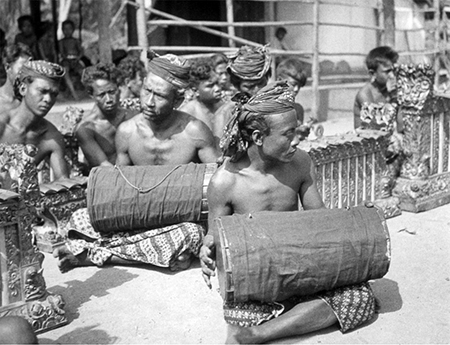 I Wayan Lotring and I Wayan Raping play kendang in a gamelan palégongan in Kuta, Bali, circa 1931-’38. Photo by Colin McPhee.
The Gamelan Pelegongan
As its name indicates, the gamelan pelègongan is the semar pegulingan, which mainly accompanies the dances of Lègong. It also has a large repertoire of melodies of all kinds, many of which were composed in the 1920s and ’30s. It also accompanies the Parwa, an ancient sacred drama, the oldest form of Balinese theater. Currently, the rare gamelan pelègongan that still exist are used for the dances of Barong and Calonarang according to the specialization of the musicians. But these ensembles are becoming increasingly rare because, due the pressure of tourism, the instruments are being melted down and recast to make standardized gamelans of the gong kebyar type usable in the accompaniment of all kinds of dances, while the gamelan pelègongan remains very specialized.
The disappearance of these orchestras is dramatic because they are by far the most admirable instrumental ensembles in Bali. Made of bronze and gold, their alloy gives them crystalline and sparkling sounds of beautiful purity. Unlike the common Balinese gamelan, there is no metallic and dry hardness due to the striking of the mallets, but on the contrary, a softness and a fullness of nuances that only these ensembles provide. There are currently less than 10 gamelans of this type left on the island.
The Lotring gamelan comprises four large gender with thirteen blades played with two mallets and giving the melodic line called pokok; these are the gender gedé tiga belas with clear and soft tones. This quartet of gender always introduces the melody. The solo at the beginning of each melodic line is given by two other groups of four gender with five blades, the kantil and penyatjah, whose alternating playing (with a single mallet) creates a complex and brilliant figuration characteristic of the pelégongan gamelan.
A paraphrase of the melodic line is given by four other high gender with five blades, the gangsa jongkok. In the low register, the melodic theme is supported by the jublag and the jegog, gender with five blades. To this melodic ensemble are added punctuation instruments: a small horizontal bulbous gong, kelènang, placed on a wooden base, generally marking the ostinato or sometimes certain secondary beats; two suspended gongs, the kempur with a deep and serious sound and the higher-pitched kajar; finally the kemong, a small suspended gong tuned outside the five degrees of the scale giving the gamelan a sixth degree of a particular coloration. Finally, a set of small rinchik cymbals and the two kendang drums complete the gamelan (the compositions presented here are conducted by only one kendang held by Lotring).
Lotring’s pelègongan gamelan is tuned approximately according to the following scale: D – E flat – F – A – B flat, the kemong being a G flat. The gender gedé are of an extremely difficult technique and require a high level of musicality from the musicians. The two mallets play in octaves but can sometimes create a complex polyphony. The solo they play in the introduction creates the atmosphere of the composition. The most beautiful works for gamelan pelègongan are mostly by Lotring.
Lotring did not write only for dance. The compositions in which he shows the most inspiration and originality are for the most part independent pieces played either as an introduction to the show or as an interlude between the various episodes of the dances. These interludes, called penyelah when they are compositions with repeated themes or perèren when they are freer and more varied in style, made Lotring famous. Each of these compositions, by their freedom of form, is not linked to any other musical category in Bali.
While the composition is often the anonymous work of a group of musicians, or even of a single artist whose name is immediately lost due to the community spirit that reigns in every act of Balinese life, Lotring was an exception to tradition, thanks to a particular creative genius that sets him outside the traditional Balinese musical norms. In the west, Lotring would have been recognized as one of the great composers of the 20th century. But in Bali, his fame has barely reached us; a modest musician inspired by the gods,
Lotring is only a link in Balinese music. However, there remain several hundred of his melodies that the rare gamelan pelègongan still sometimes play during festivals. Although their composition—and transmission—is essentially oral, the works of Lotring, among others, by their artistic level, should definitively make the western public understand that we are not in the presence of some exotic folklore, but some of the most elaborate music in the world.
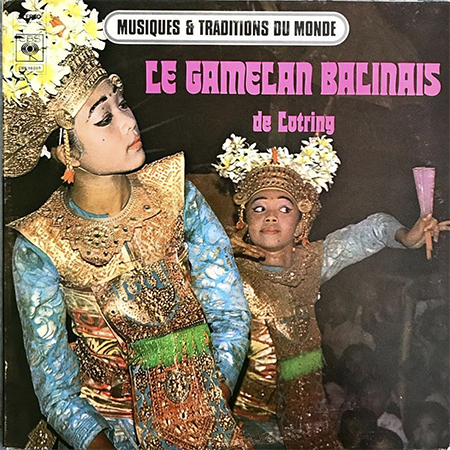
The Recordings
After numerous rehearsals preceding each recording session, the recordings were made outdoors, under the shelter of the gamelan, over the course of five evenings between October 2-11, 1972. Lotring only gave his approval after listening to the recorded tapes immediately afterward or the following day at home. He made every effort to ensure that his part— the kendang drum—was absolutely perfect and, as far as possible, that the cohesion of his musicians was as good as possible; which, because of their age and lack of permanent training, could not always be the case.
But, Lotring obtained from his musicians all the nuances he desired and some sessions took place in an atmosphere of extraordinary musical tension. The first two compositions on this side are among the most original that Lotring has ever made. Absolutely free in form, they are built on contrasts of melodic themes and rhythms used alternately.
1. Liar Samas. Liar Samas was composed around 1920 following the anecdote discussed above. After the opening solo of two gender gedé, the drum accompanied by the gong introduces the first melodic section. It consists of two parts, each repeated once. A second, slower section highlights a more developed ornamentation of the kantil and penyatjah; the melodic phrase is built on a swinging rhythm during which Lotring makes syncopated interventions of great beauty. This second section introduced by five calls in unison from the orchestra is splendid. Thanks to its original ornamentation, it sometimes brings to mind a game of carillon.
The kantil are at first discreet, then on a slight crescendo, merge in unison with the gamelan and draw a decorative lace around the theme. This part was thought up by the composer at the moment when he was looking for change he dropped on the floor. Each measure is enveloped by the sonorities of the strokes of the kempur gong alternating with the small kemong gong, which gives a particular coloring to this passage during which the drum intervenes only to change the rhythm and finally to introduce the third section.
There is no other gamelan in Bali on which one can obtain such crystalline and shimmering sonorities. These short themes, easy to follow, are in fact of a extreme difficulty of execution both technically and in terms of the nuances of striking imposed by the composer. The third section, quite brief, introduces new themes that intertwine with one of the themes from the beginning. Analyzed in detail, this composition is teeming with ideas and rhythmic innovations of exceptional difficulty.
2. Gambangan. Composed in 1926, Gambangan caused a sensation in Bali as soon as it was performed. It is Lotring’s most famous; the particular style invented on this occasion by the composer from a traditional rhythm reserved for an archaic sacred ensemble called gambang shows how Lotring could arrive at an original composition from already existing formulas by the contribution of inspired ornamentation and timbres from which he draws the maximum. Gambangan is divided into three sections: a short introduction in unison, a main section composed on two distinct melodic themes, and a brief conclusion.
The main section is built on two themes and two rhythmic systems. The emphasis is mainly on the syncopated ornamentation of the kantil; a captivating sound atmosphere is maintained by the ostinato beat of the kajar gong. A brief interruption separates this section from the conclusion played in unison. It is difficult to know what to admire most in this work: the conciseness of the composition. The choice is maintained, as in most of the recordings presented here, by the energetic interventions of Lotring, who does not hesitate at times to stimulate his musicians with voice and gesture.
3. Kapi Radja. The performance of Kapi Radja, serving as an introduction to the lègong dance, is even more significant thanks to the passion and power that Lotring displays as soon as he takes up the drum. This old man’s interventions are precise, sometimes with a dizzying virtuosity. Composed on a constantly repeated theme, Kapi Radja is organized around a perfect placement of each instrumental part, which gives a very great freedom of nuances in the dynamics.
4. Sisyan. Sisyan was one of Lotring’s very first pieces, composed when he was very young, and accompanied the dance theater of Calonarang with his gamelan. This composition accompanies the evolution of the witch’s servants, the Sisyas. This work is composed of two parts; the first is based on a brief melodic motif constantly repeated on a rhythm that produces a permanent swing of the musical phrase; the second part is made of two parts that use simple motifs. The interest of this composition is mainly due to the complex and dynamic accompaniment of the drum on the ostinato, which must be maintained throughout the piece.
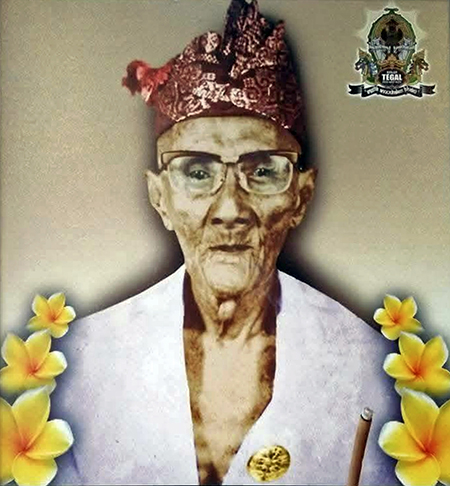 I Wayan Lotring, circa early-1970s. Photo by unknown.
5. Chandra Kanta. Chandra Kanta serves as a musical interlude to the Lègong. Without a defined rule of composition, it includes three sections contrasting with each other. Lotring here does research on rhythms, particularly for the drum part to which he brings an infinite variety of procedures. The melodic part is however supported by an admirable kantilan, weaving behind the musical phrase a dense and varied background.
6. Pelayon. Pelayon is Lotring’s favorite work because, he once told me, “It is the most refined and elegant piece that I have composed, and above all the most mystical.” Mysticism is quite difficult to define in aesthetics in Bali because it is found at every level of artistic creation. In music, it is manifested mainly by very slow tempi and rhythmic models taken from the repertoire of the great gamelan of the temples, the Gong Gedé. Lotring composed Pelayon to include in the dance of the Lègong as Pengipuk, that is to say as an accompaniment to a dance of love. This piece was composed for a choreography and therefore forms a whole with the dance that cannot be dissociated. It develops in three sections forming a dramatic progression. Throughout the work, the art of nuances is pushed to the extreme, as is the dance itself in this episode. After several listens, we better grasp the delicacy and refinement of “touch” that great Balinese musicians can achieve on metal blades (especially in the second part).
7. Lègong Kraton: Condong and Pengawak. This is a historical recording that you are invited to listen to here. Indeed, the Lègong Kraton that you hear everywhere in Bali today is almost always the version that Lotring composed around 1920 from the old melodies that prevailed before him. But currently, the Balinese gamelan tend to perform these melodies at very fast tempi and on a dazzling ornamentation to the point that to make this music more virtuoso, many musicians have made changes to it over the years. But here we find the original composition as Lotring had conceived it, with his art of nuances and breathing (listen in this regard to how he creates silences on certain gong strokes!).
The slowness with which he conducts his ensemble (because for today’s Balinese musicians, these tempi are very slow) gives much more relief to the main melodic phrases that he thus internalizes. We are far from the haste of current gamelan whose art is mainly based on virtuosity. These first two parts accompany pure dances: The first, the dance of the Condong servant which introduces all Lègong dance; the second, Pengawak (at 10:30), is totally abstract and based on very static choreographic movements. After the gender solo, the kantilan becomes aerial, almost inaudible from repeated fixed formulas. From time to time, the slow musical sections alternate with fast passages, causing breaks in rhythm, a common process in Balinese dance since the beginning of the 20th century.
8. Lègong Kraton: Lasem Garuda. The last part of the Lègong Kraton is figurative and dramatic. It relates the failed kidnapping of Queen Rangkesari by King Lasem followed by a bird of ill omen that arrives to announce the imminent death of the king. Divided into two parts (seduction of the queen, then the arrival of the magic bird and its fight with Lasem), this piece is built on the model of several brief themes constantly repeated. This last part is interchangeable in the dance because the Legong can represent many legends and there are nearly a hundred different compositions to illustrate the chosen legend.
9. Gender Wayang: Sekar Gintotan. Lotring was famous not only for his kendang playing but also as a gender player which is how he made his debut as a musician. The gender wayang is a quartet of 10-blade instruments suspended on resonators. The gender: a pair of low-pitched genders (played here by Lotring), which are the conducting instruments, are associated with two smaller genders tuned an octave higher. This ensemble accompanies performances of Wayang Kulit, the Balinese shadow theater.
It is undoubtedly in the gender wayang that Balinese music reaches the heights of refinement. This intimate music (also performed during certain family ceremonies such as a tooth filing) exudes a delicate charm. It requires cohesion and technical skill from the musicians. Indeed, their two hands perform different melodic and rhythmic formulas. The left hand of each musician (seated face to face to better synchronize their playing) plays the same melodic line while their right hand performs different melodies; we therefore sometimes obtain a polyphony with three or even four voices. The musicians of the high registers double the left hand playing of the two low registers one octave higher, each right hand remaining independent.
The tuning of each gender pair is slightly offset in order to “break up the harmonics and thus give an impression of breadth.” Lotring composed many melodies for the gender wayang and also adapted basic melodies to make personal versions. These recordings were made on the musician’s instruments, those he has used since childhood. They are tuned to the following scale: F sharp – G sharp – B – C sharp – E. Sekar Ginotan is a traditional composition for which Lotring added a new ornamentation. It is built on two main themes that alternate; a very great softness emerges from this composition.
10. Gender Wayang Pemungkah. Gender Wayang Pemungkah is a traditional composition that serves as an opening for shadow theater. Unison passages alternate with polyphonic passages in three and four voices; the music goes from agitated and energetic movements to lyrical and calm movements, from pianissimo to forte. Each section has its own atmosphere and can be listened to independently of the others. The timbre of the instruments is so beautiful that the musicians manage to extract sounds from them that are rarely heard elsewhere. Lotring’s great art consisted precisely of being able to create a new sound world from a particular sense of polyphony and, on a technical level, from a “strike” with a thousand facets.—Jacques Brunet
Le Gamelan Balinais de Lotring 2-LP was reissued on CD in 1989 and 2019.
Also Available:
Bibliography on Lotring
Colin McPhee: A House in Bali, New York, 1946
Colin McPhee: Music in Bali, New Haven, 1966
